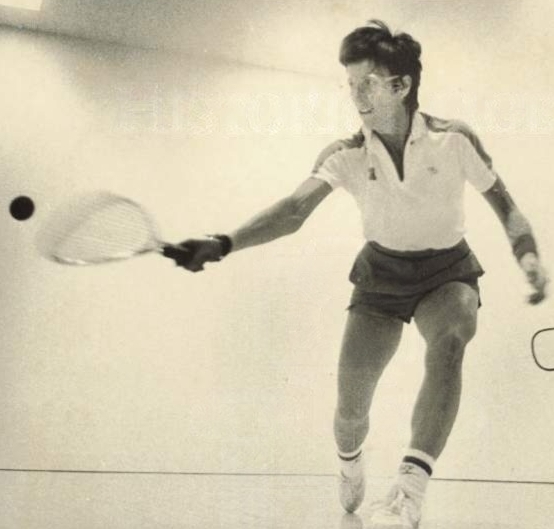
Heather McKay
Geoff Hunt
Stat by stat
Bars are scaled to the leader in this list.
The verdict
Heather McKay leads 3 of 4 categories. Our all-time ranking places Heather McKay at #2 and Geoff Hunt at #5.
Head-to-head FAQ
Who leads more shared metrics?
How do the published ranks compare?
Are these live stats?
The case for Heather McKay
The most complete domination in the history of any racket sport. McKay lost exactly two competitive matches in her entire career, both in 1962, and was never beaten again — a run of roughly nineteen unbeaten years. She won sixteen consecutive British Opens from 1962 to 1977, when the British Open was the sport's world championship in all but name, and then won the first two Women's World Opens in 1976 and 1979, giving her eighteen major titles. She also won the Australian championship fourteen times. Her superiority was so absolute that contemporaries struggled to describe her weaknesses, and when she retired she switched codes and won the women's world racquetball championship as well. The standard argument against her is field depth: women's squash in the 1960s was smaller and less professional than the men's game. The standard answer is that she never lost to anyone, for two decades, in any of it.
The case for Geoff Hunt
The bridge between the amateur game and the modern professional one, and the man who beat everybody before Jahangir Khan arrived. Hunt won eight British Opens between 1969 and 1981 and the first, second, fourth and fifth World Opens in 1976, 1977, 1979 and 1980 — twelve majors — after collecting multiple world amateur titles in the late 1960s. He matched Jonah Barrington's training revolution and added a far superior technical base, and their rivalry through the 1970s defined the decade. His last great act was the 1981 British Open final, in which he beat the 17-year-old Jahangir Khan; it was the final defeat before Jahangir's 555-match streak began, and Hunt retired soon afterwards, his body worn out by the volume of work the era demanded. He later became one of the sport's most influential coaches, running Australia's national programme and shaping a generation of Australian world champions.