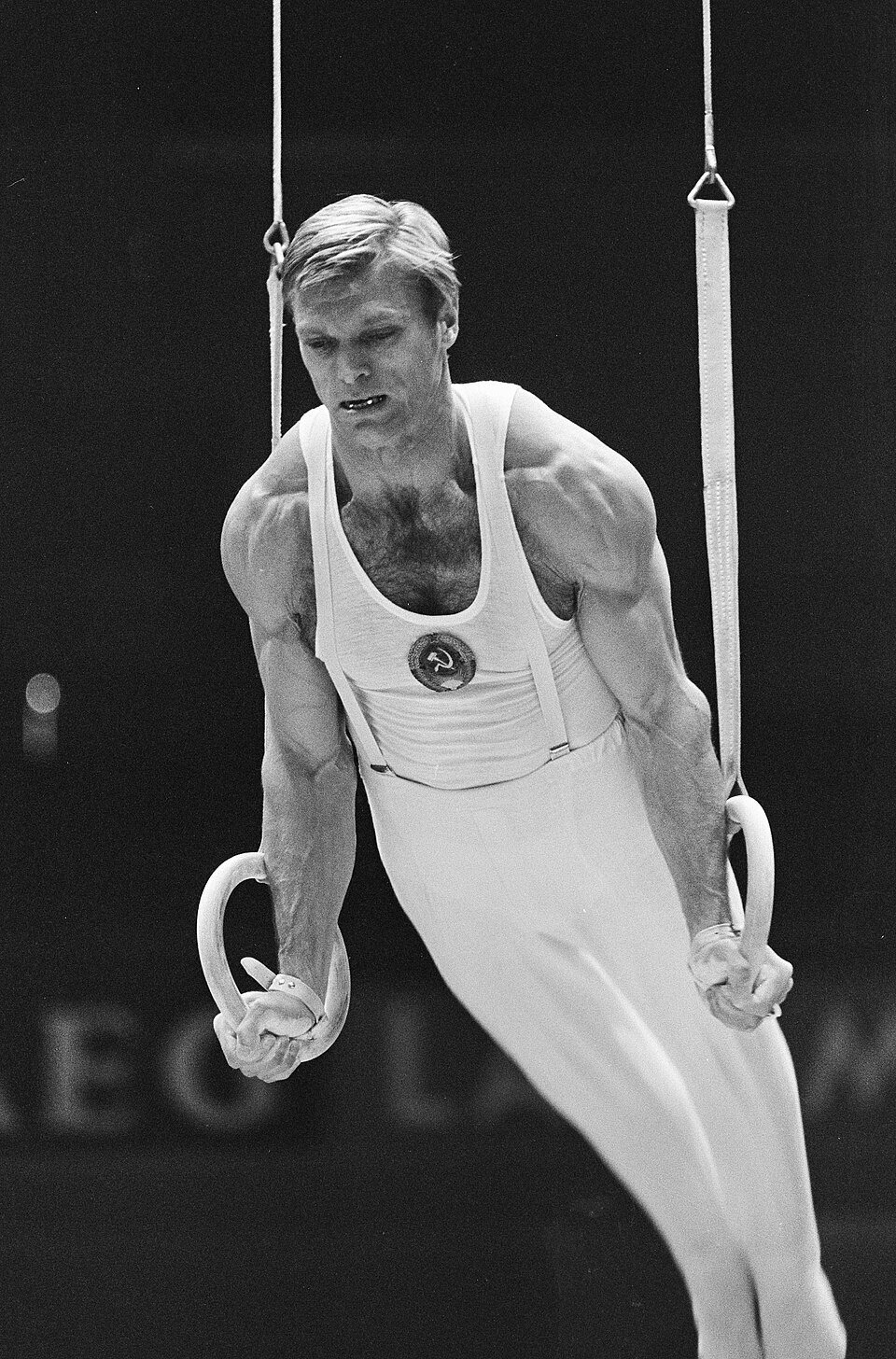
Boris Shakhlin
Li Ning
Stat by stat
Bars are scaled to the leader in this list.
The verdict
Boris Shakhlin leads 3 of 3 categories. Our all-time ranking places Boris Shakhlin at #9 and Li Ning at #11.
Head-to-head FAQ
Who leads more shared metrics?
How do the published ranks compare?
Are these live stats?
The case for Boris Shakhlin
Known as the Man of Iron for a competitive composure that never visibly broke, Shakhlin won 13 Olympic medals across 1956, 1960 and 1964 — seven gold, four silver and two bronze — the second-highest total by any male gymnast. Rome 1960 was his defining Games: he won the all-around, pommel horse, vault and parallel bars, four golds in a single Olympics, and he added the world all-around title in Moscow in 1958 to complete the set. He also collected ten World Championship medals in an era when the Soviet men's team was so deep that selection was harder than the competition itself. Shakhlin's specialism was the apparatus that punish nerve rather than power — pommel horse above all, where he won Olympic gold in 1960 and again in 1964 at the age of 32. His duel with Japan's rising generation defined men's gymnastics through the late 1950s and early 1960s.
The case for Li Ning
The Prince of Gymnasts, and the athlete who announced China as a gymnastics superpower. At the 1982 World Cup in Zagreb he won six of the seven gold medals on offer, a haul with no parallel in the sport, and at the Los Angeles Olympics in 1984 he took six medals from a single Games — gold on floor, pommel horse and rings, silver in the team event and on vault, and bronze in the all-around. He was a specialist rather than an all-around champion, and his floor and rings work in particular set the technical template that Chinese coaching would refine for the next four decades into Olympic sweeps in Beijing. His second act was as consequential as his first: he founded the Li-Ning sportswear company in 1990, built it into one of China's largest brands, and in 2008 was hoisted into the air to run around the rim of the Bird's Nest and light the Olympic cauldron in front of his own country.