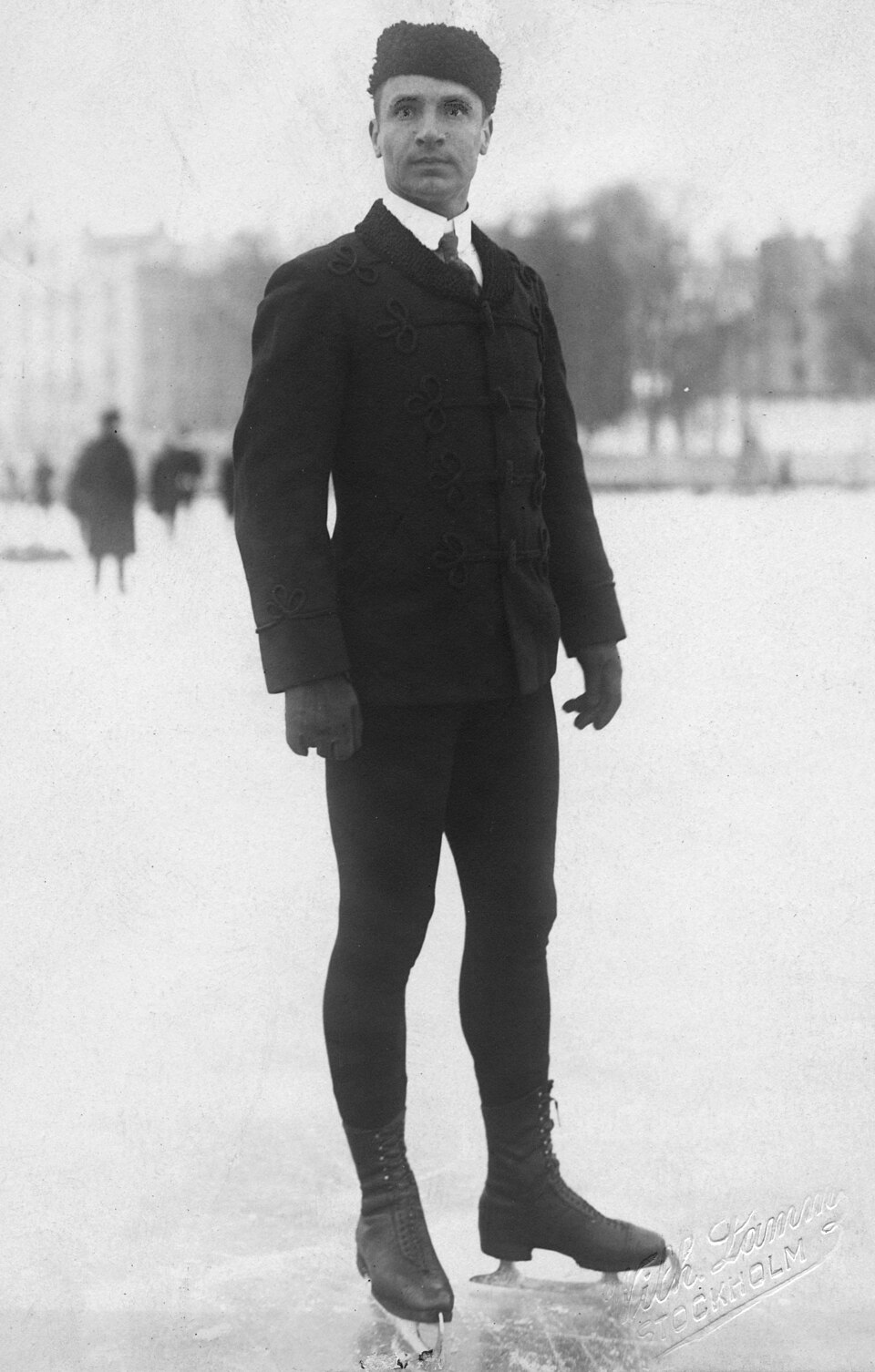
Ulrich Salchow
Yuna Kim
Stat by stat
Bars are scaled to the leader in this list.
The verdict
Ulrich Salchow leads 2 of 4 categories. Our all-time ranking places Ulrich Salchow at #4 and Yuna Kim at #11.
Head-to-head FAQ
Who leads more shared metrics?
How do the published ranks compare?
Are these live stats?
The case for Ulrich Salchow
The first great champion of organised figure skating, and the only skater whose name is spoken thousands of times a day in every rink on earth. Salchow won ten world titles between 1901 and 1911, still the men's record more than a century later, and nine European championships between 1898 and 1913. He took the Olympic title at the 1908 London Games, where figure skating became the first winter sport ever contested at an Olympics. In 1909 he performed the edge jump that carries his name, a take-off from the back inside edge with no toe assistance, which remains one of the six jumps in the modern repertoire and is the entry point for most skaters' first triple and first quadruple. He was also an administrator of consequence, serving as ISU president from 1925 to 1937 and shaping the rules of the sport he had just finished dominating. Whatever era adjustment one applies, no man has won more world championships.
The case for Yuna Kim
The most complete competitor of the pre-quadruple women's era, and the skater who built a sport in a country that did not have one. Kim won Olympic gold at Vancouver 2010 with a world-record 228.56, finishing 23 points clear of Mao Asada in the largest winning margin the modern system has produced at a Games, and took silver at Sochi 2014 in a result still disputed by judges and federations alike. She won world titles in 2009 and 2013 and the 2009 Four Continents, and was the first woman to pass 200 points overall, scoring 207.71 at the 2009 World Championships in Los Angeles. She never finished off the podium at a senior ISU championship. South Korea had almost no figure skating infrastructure when she began; by Vancouver her free skate commanded a national audience share that emptied streets, and rink construction and youth registration followed within a few years. Textbook technique, and a competition record close to flawless.