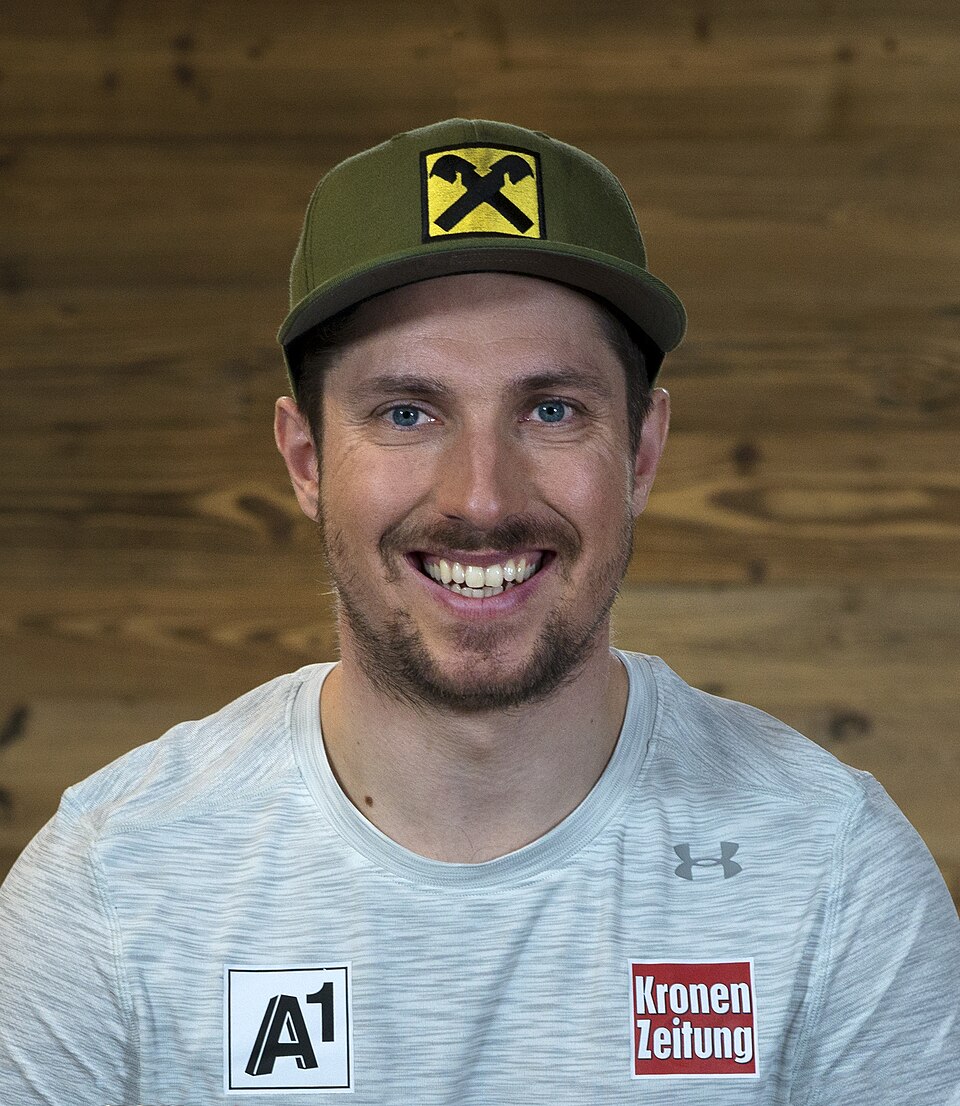
Marcel Hirscher
Jean-Claude Killy
Stat by stat
Bars are scaled to the leader in this list.
The verdict
Marcel Hirscher leads 3 of 5 categories. Our all-time ranking places Marcel Hirscher at #3 and Jean-Claude Killy at #12.
Head-to-head FAQ
Who leads more shared metrics?
How do the published ranks compare?
Are these live stats?
The case for Marcel Hirscher
The most dominant season-long racer in the history of the men's circuit. Hirscher won eight consecutive overall Crystal Globes from 2012 to 2019, a run no alpine skier of either sex has approached — Marc Girardelli's five had stood as the men's record since 1993 — and did it against the deepest technical fields the sport has staged, with Austria alone able to field a dozen plausible podium contenders. He finished with 67 World Cup wins, split between giant slalom and slalom, and seven world championship golds. The one gap was Olympic: after a silver in Sochi he finally won giant slalom and combined gold at Pyeongchang in 2018. He retired at 30 in perfect health, then returned in 2024 racing under the flag of the Netherlands, his mother's country, an unprecedented late-career switch that reopened a career everyone assumed was closed.
The case for Jean-Claude Killy
The shortest great career on this list and one of the most concentrated. Killy won the first two World Cup overall titles in 1967 and 1968, taking 12 of 16 races in the inaugural season — a proportion of a calendar no racer has since approached — and then swept downhill, giant slalom and slalom at the Grenoble Olympics in 1968, matching Toni Sailer as the only men to win all three at one Games. He finished with 18 World Cup victories in a circuit that barely existed yet, plus the world combined titles of 1966 and 1968. He retired at 24 and became the sport's first modern commercial star, later co-presiding over the 1992 Albertville Games and sitting on the IOC. His ranking here reflects an obvious limitation of era rather than of talent: there simply was no long circuit for him to dominate.