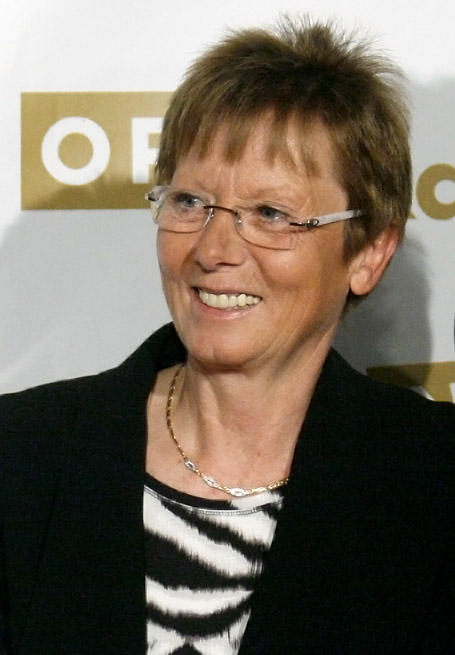
Annemarie Moser-Proll

Alberto Tomba
Stat by stat
Bars are scaled to the leader in this list.
The verdict
Annemarie Moser-Proll leads 3 of 5 categories. Our all-time ranking places Annemarie Moser-Proll at #5 and Alberto Tomba at #8.
Head-to-head FAQ
Who leads more shared metrics?
How do the published ranks compare?
Are these live stats?
The case for Annemarie Moser-Proll
The most complete dominance any woman exercised over the World Cup before Shiffrin. Moser-Proll won five consecutive overall Crystal Globes from 1971 to 1975, retired at 25, came back and won a sixth in 1979 — still the women's record — with 62 race victories in a period when the calendar was far shorter than it is today. Between December 1972 and January 1973 she won eleven consecutive downhills, a streak in a single discipline no racer has matched. She took five world championship golds and, at Lake Placid in 1980 in her final season, the Olympic downhill title that had eluded her through two silver medals at Sapporo in 1972. Contemporaries described a racer who simply attacked terrain other women managed, and her win rate across the seasons she contested remains the highest of any woman in the sport's history.
The case for Alberto Tomba
Tomba la Bomba took a sport followed by Alpine villages and made it a national event in Italy. He won 50 World Cup races — 35 slaloms and 15 giant slaloms — and three Olympic golds, taking both technical events at Calgary in 1988 and defending the giant slalom at Albertville in 1992, which made him the first alpine skier to win the same event at two Games. He medalled at three consecutive Olympics. His overall Crystal Globe came late, in 1995, and he closed with a slalom and giant slalom double at the 1996 world championships in Sierra Nevada. The numbers understate him: Tomba raced with a physical, aggressive line built on unusual leg strength, and he turned second runs into theatre, routinely coming from four or five places back. Italian television audiences for his slaloms reached levels the sport has never seen since.